Contoh Soal Reading EPrT, Jawaban dan Strategi Mengerjakannya
Mau lulus kuliah tepat waktu atau melamar beasiswa? Salah satu syarat penting yang sering diminta adalah bukti kemampuan bahasa Inggris. Nah, di banyak kampus termasuk Telkom University, ada tes khusus yang digunakan untuk mengukur kemampuan ini, yaitu EPrT (English Proficiency Test). Tes ini jadi tolak ukur penting buat mahasiswa karena hasilnya bisa memengaruhi proses kelulusan, program pertukaran pelajar, bahkan penempatan kerja magang.

Tes EPrT (English Proficiency Test) adalah salah satu jenis tes kemampuan bahasa Inggris yang sering digunakan oleh berbagai perguruan tinggi di Indonesia, termasuk Telkom University, untuk mengukur kemampuan bahasa Inggris mahasiswa atau calon lulusan. Salah satu bagian yang cukup menantang dalam tes ini adalah bagian Reading. Kenapa? Karena kamu bukan hanya diminta membaca teks panjang berbahasa Inggris, tapi juga dituntut memahami isinya secara cepat dan akurat. Mulai dari mencari ide pokok, makna kata, sampai menyimpulkan informasi yang tersirat, semuanya membutuhkan strategi dan latihan yang konsisten.
Kalau kamu sedang mempersiapkan diri menghadapi EPrT, artikel ini akan sangat membantu. Di sini kita akan bahas tuntas tentang Jenis pertanyaan yang sering muncul di EPrT Reading Competence, Contoh soal Reading EPrT lengkap dengan jawabannya dan strategi agar kamu bisa mengerjakannya dengan percaya diri. Jadi, jika kamu ingin skor EPrT-mu naik drastis tanpa harus belajar sampai begadang tiap malam, baca artikel ini sampai tuntas ya!
Apa itu Reading Section di EPrT
Reading section pada tes EPrT mengukur kemampuan kamu dalam memahami teks bacaan berbahasa Inggris. Jenis teks yang digunakan bisa berupa artikel ilmiah ringan, wacana umum, opini, hingga teks deskriptif atau naratif.
Biasanya, bagian Reading terdiri dari 3 hingga 5 teks bacaan, jumlah soal sekitar 20 sampai 30 soal, durasi pengerjaan sekitar 30 sampai 40 menit.
Jenis soal yang muncul DI EPrT Reading Competence
1. Main Idea
• Mengidentifikasi jawaban yang merangkum topik utama teks.
• Tipe pertanyaan:
What is the topic of the passage?
What is the main idea of the passage?
Which of the following would be the best title?
2. Stated Detail
• Mengidentifikasi detail yang secara eksplisit dapat ditemukan di teks.
• Tipe pertanyaan:
It is stated in the passage that . . .
The passage indicates that . . .
The author mentions that . . .
3. Unstated Detail
• Mengidentifikasi detail yang TIDAK disebutkan dalam teks.
• Tipe pertanyaan:
All of the following are true except . . .?
Which of the following is not stated . . .?
Which of the following is not mentioned . . .?
4. Pronoun Reference
• Mengidentifikasi noun yang dirujuk suatu pronoun.
• Tipe pertanyaan:
The pronoun “…” in paragraph X refers to which of the following?
The word “…” in the X sentence of the X paragraph refers to …
5. Implied Detail
• Meminta test taker untuk membuat kesimpulan dari informasi yang ada dalam teks.
• Tipe pertanyaan:
It is implied in the passage that . . .
It can be inferred from the passage that . . .
What probably happened … ?
6. Transition
• Mengidentifikasi paragraf selanjutnya ataupun sebelumnya.
• Tipe pertanyaan:
The paragraph preceding the passage probably….
What is most likely in the paragraph following the passage?
7. Vocabulary
• Mengidentifikasi arti suatu kata atau frasa dalam teks.
• Tipe pertanyaan:
. . could best be replaced by which of the following?
The word “. . .” has similar meaning with?
Which of the following is closest in meaning to . . .?
8. Tone or Purpose of the Passage
• Mengidentifikasi apa yang dirasakan oleh penulis ataupun penyebab mengapa teks tersebut ditulis.
• Tipe pertanyaan:
What is the tone of the passage?
What is the author’s purpose in this passage?
Contoh Soal Reading EPrT dan Pembahasannya
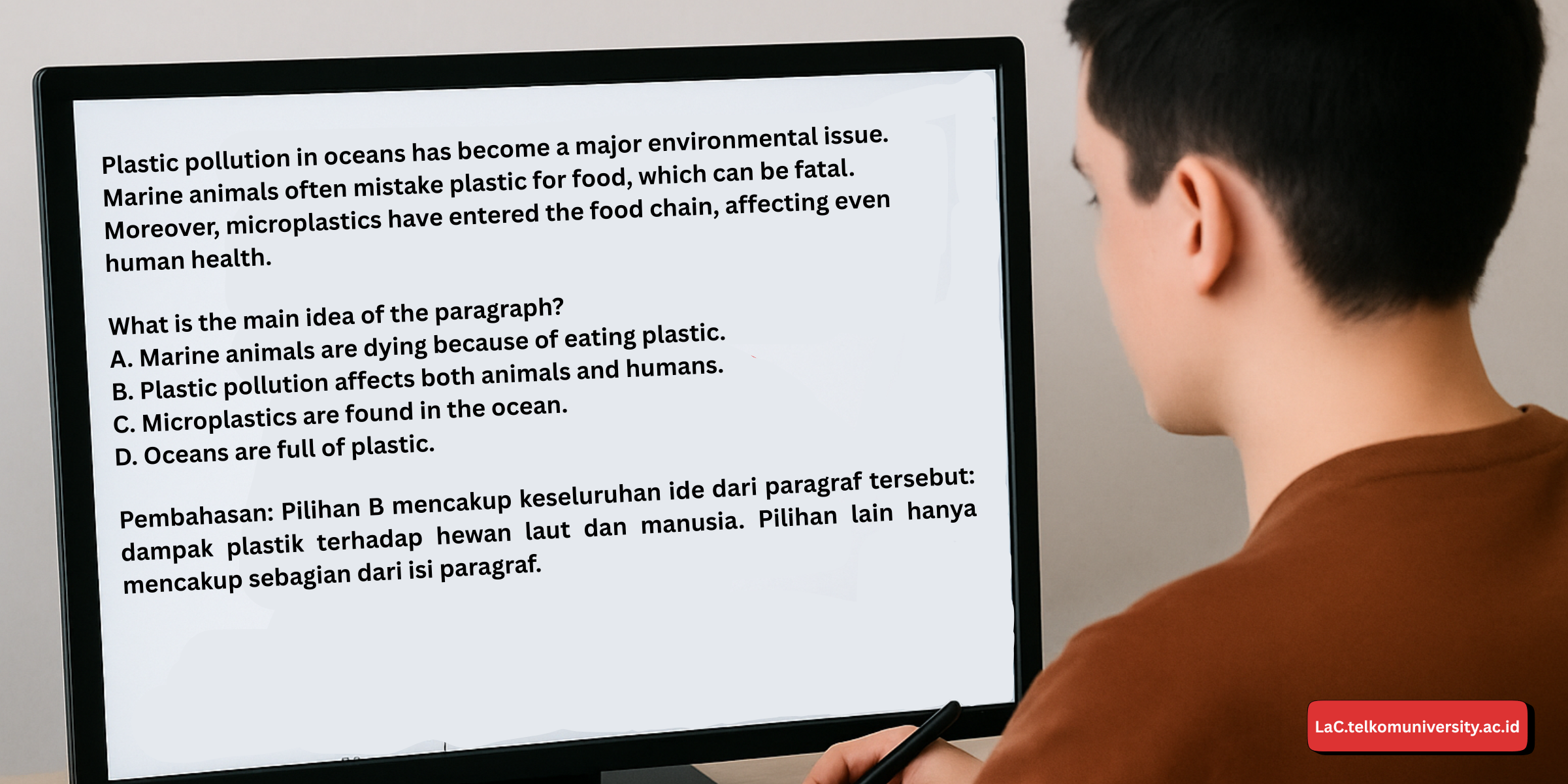
Mari kita lihat beberapa contoh soal dari teks berikut yang sering muncul dalam tes Reading EPrT beserta jawabannya.
Sloths have poor hearing and eyesight, and they’re slow—the slowest mammal on Earth. But their lethargy is an energy-saving strategy; despite the inability to outrun threats, sloths have figured out what works for them. And while they may appear to be solitary, they don’t succeed alone. Sloths operate as one-third of a partnership with moths and algae, which both live in the mammal’s thick fur.
After a three-toed sloth has lounged for days in the forest canopy, napping and grazing on poisonous leaves—slowly, so that its liver and four-chambered stomach can break down the toxins—the time comes for its weekly poop. Rather than rain droppings from high up, the animal makes a drawn-out descent.
As captured on camera in National Geographic’s Underdogs series, the move is exceptionally risky, burning a tenth of the sloth’s daily calories and exposing it to predators on the jungle floor, where it’s mostly—but not always—helpless to defend itself. More than half of the sloth deaths documented by Pauli’s team of researchers in Costa Rica occurred on bathroom breaks. But if a jaguar isn’t waiting at the tree’s base, a sloth digs a small depression in the soil—a toilet bowl—and relieves itself at last.
Cue the moths. Females, including species found only on sloths, lay their eggs in the fresh dung. The eggs become coprophagous larvae, feeding on the feces, and larvae become adult moths that flutter off in search of their own hairy habitats. As many as 120 moths have been counted on a single sloth.
Moths fertilize sloth fur with nutrients, like nitrogen, whether by delivering fecal matter there or dying and decomposing. Along with rainwater, nitrogen encourages the growth of algae. And algae give sloths a green coloring—effective camouflage from birds of prey patrolling overhead. The more moths on a sloth, the more nitrogen and algae. Sloths also eat the green stuff as a sort of dietary supplement. Although researchers haven’t observed the behavior, Pauli’s team tested the contents of sloths’ stomachs and found algae.
1. What is the main idea of the passage?
A. Sloths’ partnership with moths and algae is unusual but beneficial.
B. Sloths are helpless animals that rely on camouflage to survive.
C. Most sloth deaths are caused by predators while they defecate.
D. Moths are the only reason sloths have survived.
Pembahasan : Teks diatas membahas mengenai simbiosis mutualisme antara kungkang, ngengat dan alga. Jadi, jawaban yang tepat adalah A.
2. The pronoun “its” in paragraph 2 line 2 refers to …
A. organisms
B. sloths
C. moths and algae
D. researchers
Pembahasan : ‘its’ pada paragraf kedua di baris kedua merujuk kepada kungkang. Jadi, jawabannya adalah B.
3. The phrase “drawn-out descent” could best be replaced by …
A. quickly get out
B. rapid fall
C. slowly climb down
D. controlled flight
Pembahasan : Frasa ‘drawn-out descent’ dapat digantikan dengan ‘slowly climb down’ karena memiliki makna yang sama. Jadi, jawabannya adalah C.
4. The passage indicates that a sloth’s descent from a tree is risky because …
A. it burns calories and exposes the sloth to predators
B. it leads to competition with other animals
C. it causes damage to the tree
D. it usually results in injury
Pembahasan : Jawabannya adalah A, penjelasannya terdapat pada paragraf ketiga teks diatas.
5. All of the following are true EXCEPT …
A. Sloths eat algae as part of their diet
B. Moths lay eggs in sloth droppings
C. Sloths use their tails to bury their feces
D. Sloths have a slow metabolism to process toxins
Pembahasan : Jawabannya adalah C. Semua pernyataan diatas benar, kecuali C.
6. “Females” in paragraph 4 line 1 refers to which of the following?
A. Eggs
B. Moths
C. Sloths
D. Larvae
Pembahasan : ‘Females’ pada paragraf keempat baris pertama merujuk kepada ngengat. Jadi, jawaban yang tepat adalah B.
7. The word “flutter” in paragraph 4 line 3 is closest in meaning to …
A. fix
B. glide
C. crawl
D. fly
Pembahasan : ‘flutter’ diatas memiliki makna terbang. Jadi, jawaban yang tepat adalah D.
8. According to paragraph 5, which of the following is stated?
A. Sloths eat moths as a protein source
B. Algae on sloth fur helps them blend into the environment
C. Rainwater washes algae off the sloth’s fur
D. Researchers observed sloths picking algae from leaves
Pembahasan : Kalimat yang tertulis pada paragraf kelima teks diatas adalah B.
9. What is the author’s tone in the passage?
A. Humorous and dismissive
B. Curious and respectful
C. Sarcastic and emotional
D. Bored and indifferent
Pembahasan : Teks diatas menunjukkan ketertarikan dan rasa penasaran penulis terhadap hubungan yang terjalin antara kungkang, ngengat dan alga. Jawabannya adalah B.
10. What would most likely be discussed in the paragraph following this passage?
A. Research on sloth microbiomes for new antibiotics
B. The predators that feed on sloths
C. The digestive system of moths
D. Reasons why algae thrive in humid environments
Pembahasan : Jawabannya adalah A.
Strategi Mengerjakan Soal Reading EPrT
Berikut beberapa strategi yang bisa kamu gunakan:
1. Skimming dan Scanning
• Skimming digunakan untuk menangkap ide umum dari bacaan.
• Scanning digunakan untuk mencari informasi spesifik dengan cepat, misalnya angka, nama, atau kata kunci.
2. Baca Pertanyaannya Dulu
Sebelum membaca teks, lihat dulu pertanyaannya. Ini membantumu fokus pada informasi yang perlu dicari.
3. Highlight Kata Kunci
Jika kamu mengerjakan di kertas atau aplikasi yang memungkinkan, tandai kata kunci pada pertanyaan dan teks.
4. Perhatikan Kata Hubung dan Transisi
Kata seperti however, therefore, in contrast memberi petunjuk hubungan antaride.
5. Latihan Rutin dengan Timer
Gunakan stopwatch saat latihan agar terbiasa dengan batas waktu pengerjaan.
Menghadapi soal Reading dalam tes EPrT memang butuh usaha ekstra, tapi bukan berarti tidak bisa dikuasai. Dengan strategi yang tepat, latihan soal secara rutin, dan pemahaman terhadap berbagai jenis teks serta pertanyaan, kamu bisa meningkatkan kemampuan membaca bahasa Inggris dengan signifikan. Kuncinya ada pada konsistensi belajar dan kemauan untuk terus mencoba, meskipun awalnya terasa sulit.
Kalau kamu merasa butuh bimbingan yang lebih terarah dan sistematis, kamu bisa bergabung dengan Kursus EPrT Reading Preparation yang diselenggarakan oleh Pusat Bahasa Telkom University. Kursus ini dirancang khusus untukmu yang ingin memperdalam kemampuan Reading di EPrT. Selama 10 pertemuan, kamu akan dibimbing langsung oleh instruktur berpengalaman, mempelajari strategi membaca teks akademik, mengenal format soal, hingga mengerjakan simulasi dengan feedback yang membangun. Tersedia juga pilihan kelas daring dan luring yang fleksibel sesuai kebutuhanmu.
Nah, jika kamu membutuhkan skor EPrT sebagai syarat untuk kebutuhan tertentu dan merasa sudah siap menghadapi tesnya, kamu bisa langsung mendaftarkan diri untuk Tes EPrT di Pusat Bahasa Telkom University. Yuk, manfaatkan kesempatan ini untuk mengembangkan kemampuan bahasa Inggrismu lebih jauh. Ingat, langkah kecil hari ini bisa jadi lompatan besar untuk masa depanmu. Semangat belajar dan sampai jumpa di kelas EPrT Reading Preparation!
Penulis: Pusat Bahasa Tel-U | Editor: Auliya Rahman P | Foto: Pusat Bahasa Tel-U
Eksplorasi konten lain dari Telkom University Language Center
Berlangganan untuk dapatkan pos terbaru lewat email.
